The Banality of Formal Writing
If you came here through Reddit, I recommend my follow-up article.
If you set foot in a school in pretty much any country in the last couple hundred years, you probably came across a whole system of education devoted to teaching you “formal writing”. But did we ever think critically about “formal writing”? Did we ever evaluate its use and why it exists?
First of all, what is Formal writing? Note that for the time being, I capitalize “Formal” because I claim that we do not know what this means as of yet (“writing” is in lowercase because “Formal writing” is a type of writing).
The Grammarly blog tells us that “formal writing is used for serious topics and readers that you don’t know very well” whereas “informal writing is more relaxed and used for writing with friends or light-hearted conversations with anyone you’re familiar with.” In a similar manner, the Microsoft 365 Life Hacks blog tells us that “[f]ormal writing has a less personal tone and the language is more proper.” In general, most resources tell us that Formal writing is complex and impersonal, but really the root of it all is seriousness and propriety. At the end of the day, you write impersonally and in a complex way because you want to evoke that you are serious and that you do what you do properly.
But if you look throughout the history of humanity, you will find many texts that treated serious topics properly, which nevertheless are not Formal. For instance: Nietzsche, the Bible (don’t let King’s translation fool you), Plato, and Martin Luther King Jr.1 These works have been highly respected, across diverse sects, and they have not been deemed unserious or improper; at least not because of their informal writing. So, non-Formal writing—I don’t want to use the word “informal” because it implies value judgments, but mainly because it implies we know what formal writing is—has been used successfully to get across pretty serious messages. One cannot help but wonder, then: what is Formal writing, really?
Here is my proposal, which to the best of my knowledge is novel: the word “formal” in “formal writing” has basically the same function as “formal” in “formal logic”. In other words, it has to do with the form and not the seriousness or propriety of the message, even though that is how people think of it.
But let us take a step back: what is formal logic? Britannica gives us a definition:
[T]he abstract study of propositions, statements, or assertively used sentences and of deductive arguments. The discipline abstracts from the content of these elements the structures or logical forms that they embody.
This probably does not make much sense, so allow me to explain. The emphasized (by me) pieces are the key. You see, logic can be done in all sorts of forms, for example by just writing arguments in English, like the following:
- If I make out with my boss’ daughter, then I will get fired.
- I made out with my boss’ daughter.
- Therefore, I am fired.
Let’s write another argument:
- If it rains, then I will need an umbrella.
- It is raining.
- Therefore, I need an umbrella.
Now, if we look at both of these arguments, we may notice that they basically have the same structure, even though the contents are different. They are both of the form:
- If P, then Q.
- P is true.
- Therefore, Q.
In the first case, P is “I make out with my boss’ daughter” and Q is “I get fired.” In the second case, P is “It rains” and Q is “I need an umbrella”. Part of the point of formal logic is exactly to realize that these two arguments have the same structure, i.e., the same form, and then realize that any argument that has that form works basically the same way regardless of the contents; of what P and Q are every time. In this case, the generic form or argument is: if P leads me to Q and I have P, then I have Q. This is what Britannica’s definition means when it says that formal logic “abstracts from the content of these elements the structures or logical forms that they embody”: the specific contents don’t matter, it’s the generic form we are interested in. By extracting this generic form, you can study it independently of what P and Q are in each particular instance.2
Now that we have a grounding in formal logic, let us try to understand my proposal: formal writing—and now I use lowercase because its intensional meaning follows its use—is really about form and not seriousness or propriety. Of course, formal logic and formal writing are not exactly analogous. The point of formal logic is to extract forms to study them. In contrast, formal writing doesn’t try to extract writing forms to study them. But what it does (intentionally or not) is that it prescribes certain forms, and makes the writer follow them (and only them). If you are writing “formally”, there are certain forms you are not allowed to stray far from, and that is what the tutorials try to teach you. To see that in practice, let’s return to the Grammarly blog. After telling us what formal and informal writing are, it gives us a “formal writing techniques” section, which instructs us:
- no slang, idioms, or colloquialisms
- no exclamation points
- no contractions
- minimal pronouns
- no ambiguity
- emphasis on correct spelling and grammar
- personal feelings and opinions kept to a minimum—just the facts!
Note that basically all of them tell you what not to do. What about the “informal writing techniques”?
- slang, idioms, and colloquialisms
- exclamation points, even multiple ones (!!!)
- contractions are used freely
- pronouns are used freely
- emoji are used freely
- flow can meander or go off on tangents
- topics can be described as thoroughly or as vaguely as the writer chooses
- spelling and grammar are not a priority
Do you see the sharp contract? These “techniques” are now about what you can do, not what you cannot do. In fact, there is really no form (pun intended) of writing that is not allowed in informal writing. For example, you can avoid contractions if you want, you can be ambiguous, you can use incorrect spelling and you can express your feelings. On the other hand, in formal writing you cannot do whatever you want; you have to use a very specific form, and the educators are all ready to discipline you until you learn to follow that form. And if you don’t, you get a bad grade.
When we view the whole endeavour from that perspective, it is basically absurd. I remember in school there were instances when someone wrote a kickass essay; it made perfect sense (i.e., “full marks” on coherence) and the content was deep and insightful. But the kid got a B or a C because it was “informal” or “colloquial”. Now that I am a PhD student, I have seen reviews of my or other people’s papers that complain that the paper is not written in a formal style. Note that this complaint does not refer to coherence, precision, respect, or generally how scholarly a work is. It is a complaint just about the form. Basically, formal writing in paper writing is similar to the overall template you have to use (font size, double- or single-column, etc.), which if you don’t, your paper will get desk-rejected.
I do not think we need to ponder hard enough over such examples to realize that we cannot justify them. If the content is non-trivial and it is expressed in a comprehensible way, what else is there to have? That is basically all I need when I read non-fiction. Do you care at all whether a non-fiction book follows the very specific forms formal writing requires? In fact, I am pretty sure that some of the most engaging non-fiction you have read was not formally written (e.g., Martin Luther King Jr.’s or Malcolm X’s writings).
There is also this misconception that to be precise you need to use formal writing. This makes even less sense on multiple dimensions. First, formal writing—as the tutorials told us—requires complex sentences. But complex sentences usually increase, not decrease ambiguity. For example, you can end up with ambiguities like: did you mean “A and (B or C)” or “(A and B) or C”? Then second, if you really want to be precise, you want to use numbers and plots. Whether you put in the correct number seems to have nothing to do with whether you use “don’t” or “do not”.
Unfortunately, I am convinced this absurdity will not go away any time soon for the same reasons that bureaucracy is not going away any time soon. In fact, the roots are much deeper, and they boil down to the fact that humans like forms because they make our lives easier, particularly because we need not bear any responsibility. A process is a form, bureaucracy is a form, formal writing is a form. A form is a set—the set—of rules you are not supposed to disobey, the path of righteousness. People do not diverge because that leads to some form of punishment, but that is only half the story. You see, as long as you follow the prescribed set of rules, you are not responsible for anything that happens; the one who created the rules is (and conveniently enough, that person or institution is often so powerful or high up in the hierarchy that they usually do not face any consequences anyway).
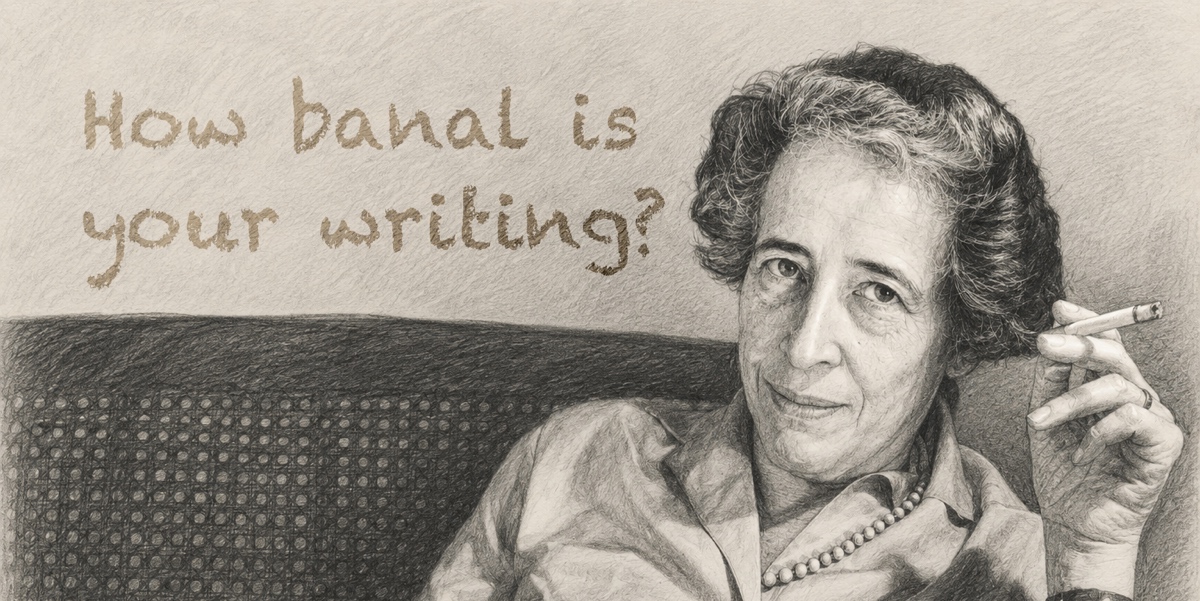
Many works have been devoted to atrocities that have been committed because someone was “simply following a process”. The most famous is probably the Milgram experiment, but my favorite is Arendt’s Eichmann in Jerusalem: A Report on the Banality of Evil. Arendt reported on the trial of Adolf Eichmann, one of the major organizers (but not minds!) of the Holocaust. The main point of the book is that Eichmann was basically a thoughtless, characterless, spineless pawn who was simply “doing his job”. Thus, he claimed, he was not responsible; those who gave him the orders were. In fact, this was such a common defense used in the Nuremberg trials that it became known as “The Nuremberg Defense”.
To bring it back to our topic, when you are writing a paper, your advisor will tell you to use formal writing, because—consciously or not—he/she knows that if you don’t, you will get punished by the reviewers. If Eichmann did not consider breaking ranks with the party line while committing some of the most abhorrent crimes in history, why would your advisor bother allowing you to write creatively?
- “As the hour for the evening meeting arrived, I approached the doors of the church with some apprehension, wondering how many of the leaders would respond to our call.”↩
- Another thing formal logic tries to solve is that English, or any natural language, is not particularly good at expressing such forms. For example, you can see that different appearances of P and Q within the same argument are not exactly equal. For example, in the second argument, P appears in the first statement as “it rains” but in the second statement as “it is raining”. We have to change the tense otherwise it will not make grammatical sense. This is also the kind of stuff that formal logic tries to abstract away because again, they are not important to the argument at the core.↩